 Daily Feed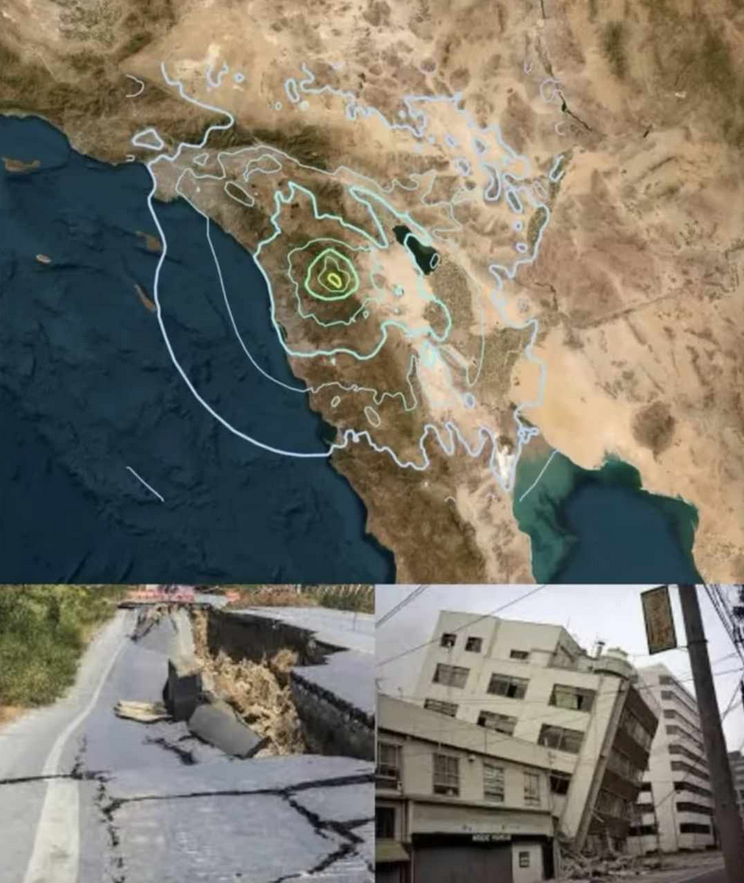
Scientists believe a significant earthquake in Southern California this week may have an unexpected cause, yet it has rekindled fears of the ‘Big One’.
Stretching more than 100 miles across Southern California, from the US-Mexico border through San Diego andRiverside Counties, and up towards Los Angeles, is the little-known Elsinore fault, a branch of the notorious San Andreas fault.Fault monitoring device
Only 15 miles from San Diego County, the Elsinore fault is among the biggest fault zones in Southern California, according to the California Institute of Technology.
Lucy Jones, a seismologist, cautioned that though Elsinore has been among the quietest in recorded history, it is still capable of produce an earthquake with a magnitude of up to 7.8.
As per statistics from the Southern California Earthquake Center and the US Geological Survey (USGS), large earthquakes with a magnitude of greater than 6.0 have occurred on the Elsinore fault every 100 to 200 years, with the last one being in 1910.
“The Elsinore fault is one of the major risks in Southern California,” Jones said after the 5.2 magnitude quake in San Diego on Monday.
“The last couple years, we’ve been having more felt-earthquakes than we had for several decades,” she added.
Source: Freepik
The USGS has developed its own estimates of what a devastating earthquake may look like if the “Big One” impacted the Elsinore fault instead of the San Andreas, since seismic activity seems to be increasing.
Devastation from that enormous disaster would probably extend from San Diego to Los Angeles and perhaps even farther.
In spite of being a distinct fault line, the Elsinore fault is a component of the greater San Andreas fault system, a collection of faults that cooperate to manage the tectonic plate movement in California.
In Southern California, Elsinore runs east of and parallel to the San Andreas. It is roughly 110 to 150 miles long and stretches through San Diego County from the US-Mexico border.
Dr. Jones attested that the Elsinore fault line’s seismic activity was linked to Monday’s seismic event.
“The Elsinore is sort of a junior sister to the San Andreas. This San Andreas breaks up when it comes into Southern California and splits into four parallel faults – the San Andreas, the San Jacinto, the Elsinore, and the Newport-Inglewood,” Jones explained to KCAL News.
Although there aren’t many earthquakes along the Elsinore, the seismologist cautioned that when they do occur, the devastation can reach Los Angeles, which is home to about four million people.
In 2017, USGS simulated a 7.8 magnitude earthquake along the Elsinore fault, which extends northwest into the Whittier fault line closer to Los Angeles.
