 Daily Feed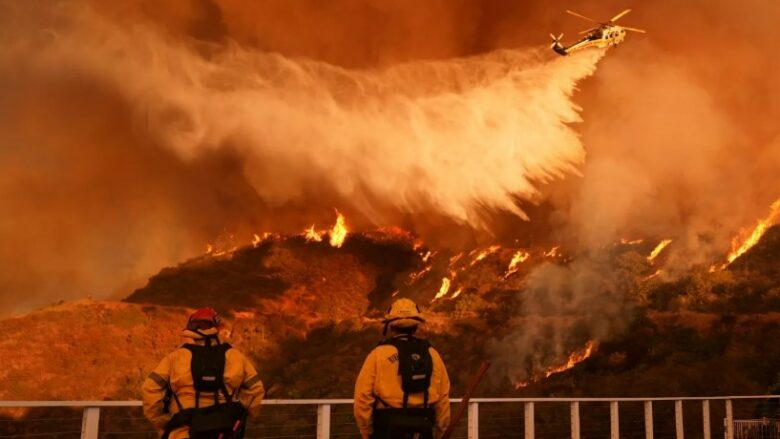
Get ready for years of even more record-breaking heat that pushes the Earth toward deadlier, hotter and more uncomfortable extremes, two of the world’s top weather agencies predict.
There’s an 80 percent chance the world will break another annual temperature record in the next five years, and it’s even more likely the world will once again surpass the international temperature threshold set 10 years ago, according to a five-year forecast released Wednesday by the World Meteorological Organization and the U.K. Met Office. “Higher global average temperatures may seem abstract, but in real life they translate into a higher chance of extreme weather: stronger hurricanes, heavier rainfall, droughts,” said Cornell University climate scientist Natalie Mahowald, who was not part of the calculations but said they made sense.
With every tenth of a degree that the world warms from human-caused climate change, “we will experience more frequent and more extreme events (especially heat waves, but also droughts, floods, fires and human-enhanced hurricanes/typhoons),” Johan Rockstrom, director of the Potsdam Institute for Climate Impact Research in Germany, emailed to me. He was not part of the research.
For the first time, there is also a chance — albeit a slim one — that before the end of the decade, the world’s annual temperature will surpass the Paris climate agreement’s goal of limiting warming to 1.5 degrees Celsius and reach a more alarming 2 degrees Celsius of warming since the mid-1800s, the two agencies said.
There is an 86% chance that one of the next five years will exceed 1.5 degrees, and a 70% chance that the five years as a whole will average more than this global milestone, they found.
The projections come from more than 200 predictions using computer simulations run by 10 global science centres.
Ten years ago, the same teams thought there was a similarly remote chance – around 1 per cent – that one of the next years would exceed that critical 1.5 degree threshold. Then it happened last year.
This year, a temperature of 2 degrees Celsius above pre-industrial levels comes into play in a similar way, something that the UK Met Office’s head of long-range forecasting, Adam Scaife, and science scientist Leon Hermanson called “shocking”.
“It’s not something that anyone wants to see, but that’s what the science is telling us,” Hermanson said.
Two degrees of warming is the secondary threshold, the one considered less likely to be breached, set by the 2015 Paris agreement.
Technically, even though 2024 was 1.5 degrees Celsius warmer than pre-industrial times, the Paris climate agreement’s threshold is for a 20-year time frame, so it hasn’t been exceeded. Taking the past 10 years into account and projecting the next 10 years, the world is now probably about 1.4 degrees Celsius warmer than it was in the mid-1800s, estimated Chris Hewitt, director of climate services at the World Meteorological Organization.
“With the next five years projected to be on average more than 1.5 degrees Celsius warmer than pre-industrial levels, this will put more people than ever at risk of severe heatwaves, bringing more deaths and serious health impacts unless people can better protect themselves from the effects of the heat. We can also expect more severe fires as the warmer atmosphere dries out the landscape,” said Richard Betts, head of climate impacts research at the UK Met Office and professor at the University of Exeter.
Ice in the Arctic – which will continue to warm 3.5 times faster than the rest of the world – will melt and seas will rise faster, Hewitt said.
What tends to happen is that global temperatures rise like riding an escalator, with temporary and natural El Niño weather cycles acting as jumps up or down on that escalator, the scientists said. But recently, after every boost from an El Niño, which adds to global warming, the planet doesn’t cool down much, if at all.
“Record temperatures immediately become the new normal,” said Stanford University climate scientist Rob Jackson.
