 Daily Feed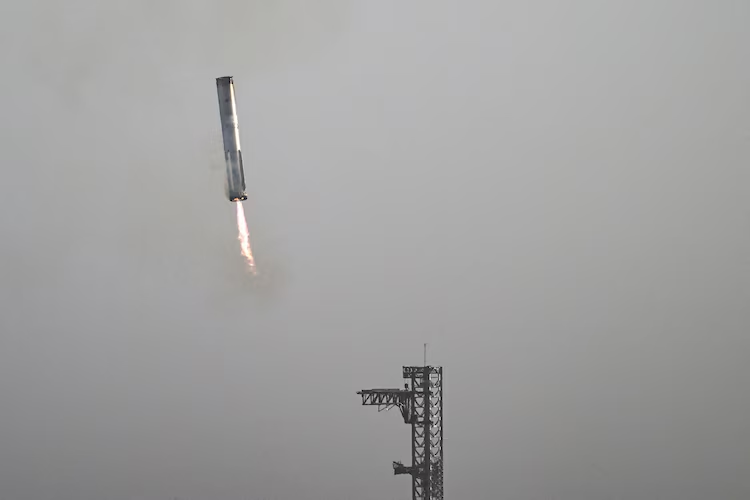
Elon Musk has long envisioned sending humans to Mars, with SpaceX’s Starship spacecraft as the key to achieving that goal. However, before making the leap to interplanetary travel, SpaceX must first prove that Starship can launch and return safely and consistently.
After two recent test flights ended in failure, the company is now preparing for its ninth unmanned test of Starship, scheduled for Tuesday evening from its Starbase facility near Brownsville, Texas. The launch window opens at 7:30 p.m. ET.
During the eighth test flight in early March, multiple engine shutdowns roughly five and a half minutes after liftoff led to a loss of control and communication. A subsequent investigation revealed that a hardware issue caused a fuel leak and ignition in the wrong section of the vehicle. Although the spacecraft wasn’t commanded to self-destruct, SpaceX believes it triggered an automatic safety response.
As the vehicle disintegrated, debris scattered over parts of South Florida and the Atlantic Ocean, prompting temporary flight restrictions at nearby airports. Social media was soon filled with dramatic images of the fiery remnants streaking through the sky.
A similar malfunction occurred in January, when excessive vibrations triggered a propellant leak and explosion. In both cases, although the upper stage was lost, the Super Heavy booster successfully returned and was caught by SpaceX’s massive robotic arms known as “chopsticks.”
Learning from these incidents, SpaceX says it has made numerous improvements to the upper stage. Despite the similar timing of both failures, the company notes the root causes were different.
As with past flights, no astronauts will be aboard this test mission.
Starship is mounted atop the 400-foot-tall Super Heavy booster, powered by 33 Raptor engines, making it the most powerful launch system ever built. Unlike the Falcon 9, which is partially reusable, Starship is intended to be entirely reusable with minimal refurbishment between flights.
This upcoming test will be the first time SpaceX uses a previously flown Super Heavy booster. The booster, which was recovered after the seventh test, will fly again with 29 reused engines. Engineers have replaced expendable parts, such as the heat shield, but left much of the booster intact to observe long-term wear.
Rather than returning to the launch site, the booster will follow a revised flight plan and perform a hard splashdown in the Gulf of Mexico, testing new descent and landing techniques. One engine will be disabled intentionally during the landing sequence to test backup capabilities.
For the upper stage, SpaceX has ambitious objectives. These include the first attempt to deploy eight Starlink satellite simulators and a planned reignition of a Raptor engine in orbit. Additionally, the spacecraft will face intense heat on reentry, with engineers deliberately exposing some areas by removing thermal protection tiles. Alternative tile materials will also be evaluated.
“Developmental testing is inherently unpredictable,” SpaceX stated in a release. “But by flying hardware often, we accelerate our ability to learn and implement improvements, moving closer to making Starship a fully reusable, rapid-launch system.”
