 Daily Posts
Supreme Court to Review Case on U.S. Birthright Citizenship
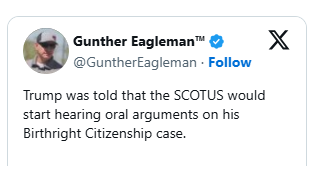
In a rare procedural move, the U.S. Supreme Court has agreed to hear oral arguments in May regarding an executive order that challenges the current interpretation of birthright citizenship under the 14th Amendment of the Constitution.
The order, signed in January, asserts that only children born to parents who are “subject to the jurisdiction” of the United States are automatically granted U.S. citizenship. This interpretation would potentially limit automatic citizenship for children born to parents who are not legal residents.
The 14th Amendment, ratified in 1868, was originally designed to grant citizenship to formerly enslaved individuals. Over time, it has been broadly interpreted to apply to nearly anyone born on American soil. However, the exact legal limits of the clause “subject to the jurisdiction thereof” have not been definitively ruled upon by the Supreme Court.
Federal courts in several states quickly blocked the executive order from taking effect. Appeals courts in San Francisco, Boston, and Richmond upheld those decisions, leading to emergency appeals by the Justice Department. The administration has requested that enforcement be limited in certain states while the legal process continues.
The Supreme Court’s decision to hold oral arguments on May 15 is notable, as it falls late in the Court’s typical term, which usually ends in June. Legal scholars say such a scheduling move signals the Court sees the issue as urgent or requiring clarification.
The last significant ruling on birthright citizenship dates back to 1895, when the Court determined that children born in the U.S. to legal resident aliens were considered citizens. Since then, the topic has remained legally settled in practice but has seen renewed scrutiny in recent years.
Supporters of a narrower interpretation of the 14th Amendment argue that the clause about jurisdiction was never intended to apply to those visiting the U.S. temporarily or residing in the country without legal permission. Others maintain that the long-standing precedent supports the broader application of birthright citizenship regardless of a parent’s immigration status.
With arguments scheduled for May, the Court’s eventual decision could have lasting implications for how citizenship is granted in the United States and how the 14th Amendment is applied going forward.

 Daily Feed